Unveiling of Unpaired Surface Spins Regulated Magnetism in 2D α-Te Nanosheets: an Implication on Magnetoelectric Driven Hydrogen Evolution

Quasi-2D tellurium (Te) unlocks surface spins (of valence 5p4 electrons) of tunable ferromagnetic order and response to strain-engineered electronic properties of widespread applications. In spin-orbit coupling, the inversion symmetry is broken in a 1S0 -> 3S1 spin-transition of the ground electronic state, a synergetic pathway to charge spin-order under applied driving forces. The surface magnetism,…

Elucidating the Mechanism of Iron-Catalyzed Graphitization: The First Observation of Homogeneous Solid-State Catalysis

Carbon is a critical material for existing and emerging energy applications and there is considerable global effort in generating sustainable carbons. A particularly promising area is iron-catalyzed graphitization, which is the conversion of organic matter to graphitic carbon nanostructures by an iron catalyst. In this paper, it is reported that iron-catalyzed graphitization occurs via a…

Direct Laser Writing: From Materials Synthesis and Conversion to Electronic Device Processing

Direct Laser Writing (DLW) has been increasingly selected as a microfabrication route for efficient, cost-effective, high-resolution material synthesis and conversion. Concurrently, lasers participate in the patterning and assembly of functional geometries in several fields of application, of which electronics stand out. In this review, recent advances and strategies based on DLW for electronics microfabrication are…

Unbroken Perovskite: Interplay of Morphology, Electro-optical Properties, and Ionic Movement

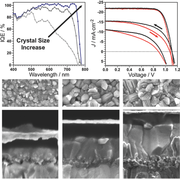
Hybrid organic-inorganic perovskite materials have risen up as leading components for light-harvesting applications. However, to date many questions are still open concerning the operation of perovskite solar cells (PSCs). A systematic analysis of the interplay among structural features, optoelectronic performance, and ionic movement behavior for FA(0.83)MA(0.17)Pb(I0.83Br0.17)(3) PSCs is presented, which yield high power conversion efficiencies…

Tuning of Cell–Biomaterial Anchorage for Tissue Regeneration

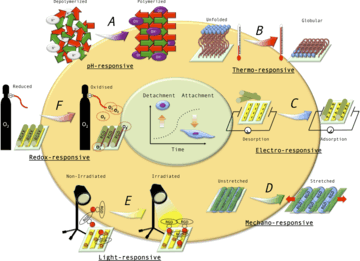
Which mechanisms mediate cell attachment to biomaterials? What role does the surface charge or wettability play on cell–material anchorage? What are the currently investigated strategies to modify cell–matrix adherence spatiotemporally? Considering the development of scaffolds made of biocompatible materials to temporarily replace the structure and/or function of the extracellular matrix, focus is given to the…

Interplay of Resonant Cavity Modes with Localized Surface Plasmons: Optical Absorption Properties of Bragg Stacks Integrating Gold Nanoparticles

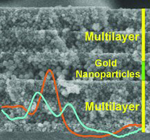
A procedure to prepare porous photonic crystal resonators containing gold nanoparticles is reported. The optical absorption of the ensemble, resulting from the excitation of the localized surface plasmon of the metallic beads, is finely tuned by a gradual shift of the cavity mode. This is achieved by infiltration of the void network with different guest…

Transparent Nanometric Organic Luminescent Films as UV-Active Components in Photonic Structures

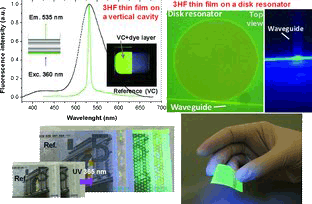
A new kind of visible-blind organic thin-film material, consisting of a polymeric matrix with a high concentration of embedded 3-hydroxyflavone (3HF) dye molecules, that absorbs UV light and emits green light is presented. The thin films can be grown on sensitive substrates, including flexible polymers and paper. Their suitability as photonic active components photonic devices…

Porous One-Dimensional Photonic Crystals Improve the Power-Conversion Efficiency of Dye-Sensitized Solar Cells

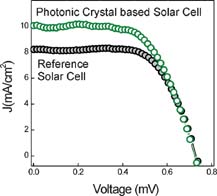
A device for solar-energy conversion was introduced in which a porous and highly reflecting 1D photonic crystal (1D PC) was coupled to a dye-sensitized nanocrystals anatase (NC-TiO2) electrode. The results show that the transparency of the PC-based dye-sensitized solar cells (DSSC) in the visible range of the electromagnetic spectrum is very similar to that of…