


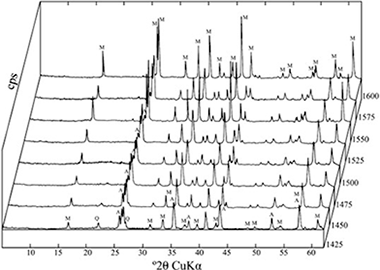
Mullite precursors were prepared using kaolin waste, sericite clay containing kaolinite and industrial kaolin with addition of alumina in a wet medium to synthesize mullite (72 wt% Al2O3 and 28 wt% SiO2). Uniaxial pressed bars of the powdered mullite precursors were fired in the range 1400-1600 degrees C with soaking times 30-120 min. The resultant materials were studied by XRD and SEM-EDX. Bulk densities, apparent porosities and flexural strengths in four points were determined in the fired bars at 1500, 1550 and 1600 degrees C. It was concluded that the thermal behaviour of these mullite precursors was influenced by the presence of impurities in the raw materials. These impurities originate a liquid phase forming a glassy phase which produces a progressive and enhanced densification of the mullite materials by reaction sintering at 1500-1600 degrees C. The technical properties were also influenced by the relative proportion of vitreous phase. The microstructure of characteristic mullite crystals was revealed by SEM. It was emphasized the use of kaolin waste by-products of mining and sericite clays as valuable raw materials for mullite preparation.