


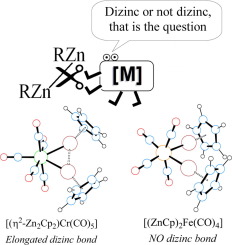
Following the synthesis of [Zn-2(eta(2)-C5Me5)(2)] (in short [Zn2Cp*(2)]) many complexes of the directly bonded Zn-Zn unit were prepared and characterized, leading to the recognition of an isolobal analogy between the Zn-Zn bond and the molecule of dihydrogen. Prompted by these results, we have investigated eta(2)-eta(2)-coordination of [Zn2Cp2] and [Zn2Ph2] (Cp = C5H5, Ph = C6H5) to several selected transition metal fragments and report herein the results of a QTAIM study of complexes [(ZnR)(2)Fe(CO)(4)], [(eta(2)-Zn2R2)M(CO)(5)]] and [(eta(2)-Zn2R2)Pd(PR'(3))(2)] (for R = Cp, Ph; M = Cr, Mo, W; and R’ = F, H, Me). A decrease of rho(BCP), Delta(2) rho(BCP) and delocalization indexes delta(Zn, Zn), relative to corresponding values in the parent molecules of [Zn2Cp2] and [Zn2Ph2], accompanied dizinc coordination. In most cases the computed d(Zn, Zn) parameters were indicative of significant electron density sharing between the two Zn atoms. Nevertheless, the interaction with [Fe(CO)(4)] resulted in oxidative cleavage of the coordinated Zn-Zn bond, due to high pi backdonation to the sigma* Zn-2 MO as deduced from the delta(M, O-CO) index. The Zn-Zn bond critical points identified in our study are discussed. The computed Zn-Zn contacts concentrate in the range 2.44-2.58 angstrom, and we propose that this interval corresponds to elongated dizinc bonds.