


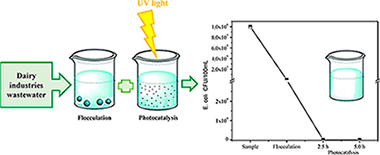
The aim of the present work was to evaluate the effectiveness of flocculation-photocatalysis as combined processes in the treatment of dairy industries wastewater. Different commercial and lab prepared flocculants and photocatalysts were evaluated. All the materials prepared were extensively characterized. Commercial materials presented the best physicochemical properties and performance in the treatment of the studied wastewater. On one hand, all the photocatalysts evaluated showed bactericidal activity for E. Coli, total coliforms and other enterobacteriaceae. Total elimination of E. coli was obtained by using commercial TiO2 P25 Evonik, under 120 W/m2 of UV–vis light intensity and 5 h of total illumination time. Other species of bacteria remained after treatment under these conditions. It was also found that the highest light intensity of 120 W/m2 led to increase the Chemical Oxygen Demand and Total Organic Carbon in the samples treated, it can be due to the faster formation of new organic compounds as intermediaries during the photocatalytic reactions at the highest photonic flux. Flocculation pre-treatment of the wastewater samples led to improve the effectiveness of the photocatalytic treatment; thus, the combination of flocculation-photocatalysis treatments at low light intensity of 30 W/m2 leads to achieve the total elimination of E. coli, and under this intensity the elimination of total coliforms and other enterobacteriaceae increased 5.48% compared to the photocatalytic treatment alone. These treatment conditions led to comply the Colombian regulations for dairy wastewater.