


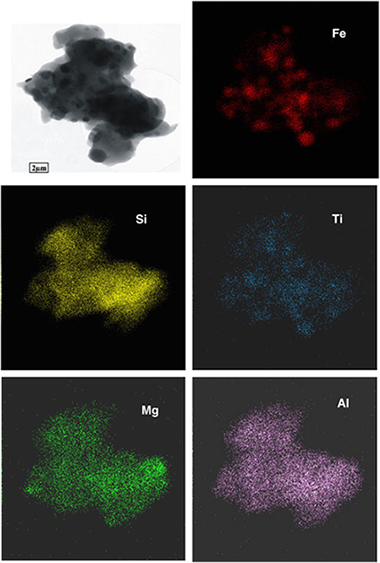
In this study, we examined the annealing effect on the material obtained after acid treatment of ground vermiculite which constituted amorphous silica and β-FeOOH. The XRD patterns of the starting sample measured at temperatures from 30 to 1200°C showed that the crystalline phase was present until ~300°C; whereas the sample heated between 300 and 800°C was practically amorphous. This is in agreement with previous observations that β-FeOOH decomposes to amorphous or poorly crystalline phase, β-Fe2O3, and transforms only slowly to crystalline α-Fe2O3. At 850°C the sample showed the first signs of a crystalline phase which was fully developed at 1050°C. The XRD, HRTEM and Mössbauer spectroscopy showed, after heating at 1050°C, the presence of crystalline phase, consisting of quartz, cristobalite, α-Fe2O3 and ε-Fe2O3. This effect showed in fact that well crystallized iron oxide nanoparticles embedded into the silica matrix are usually formed at relative high temperatures (~1000°C), which is in contrast to silica-free material. Element mapping of one particle of the composite obtained by annealing the sample at the highest temperature showed well-separated Fe2O3 and SiO2 particles in a composite material. Impurities of Al and Mg (from the original vermiculite) accompanied the silica components and TiO2 associated with Fe2O3 grains was also detected.