


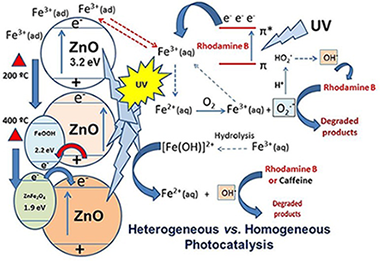
Iron (III) was incorporated, to the surface of a synthesized ZnO, using two nominal molar percentages of Fe (III): 1% and 5% Fe relative to ZnO. Samples dried and calcined at 200 °C and 400 °C for 2 h, were characterized by XRD, XPS, XRF, N2-adsorption-BET and (UV–vis)-DRS. Photocatalytic activities of the catalysts were assessed based on the degradation of rhodamine B (RhB) and caffeine (CAF) in aqueous solution under two irradiation conditions: UV and visible light illumination. Prior to the photocatalytic tests, the interaction of each one of the substrates with either Fe(III) or Fe(II) was studied in homogeneous medium under UV-illumination and oxygenated environment. It was found that Fe (III) can play an important role in homogeneous media in the photoassisted degradation, both of rhodamine B and caffeine, while Fe (II) does not exert a relevant role in the photoassisted degradation of the referred substrates. Fe–ZnO samples display similar or poorer performance than pure ZnO in the presence of UV light for both studied substrates. The phenomenon can be attributed to the formation of either goethite or ZnFe2O4 at the ZnO surface where the coupled Fe3+/Fe2+ can act as recombination centers for the photogenerated charges. On the contrary, all Fe–ZnO samples showed enhanced photocatalytic activity under visible illumination which seems to be independent of the iron content. In this context, the mechanisms for photoassisted degradation of both the substrates in homogeneous medium and photocatalytic degradation are discussed, as well as the role of Fe in the photodegradation processes.