


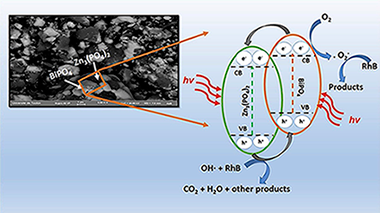
In this work, a facile method was used to synthesize the Zn3(PO4)2/BiPO4 composite photocatalysts with different Bi contents followed by heat treatment at 900 °C for 3 h. The as-prepared samples were studied by a variety of characterization techniques including X-ray diffraction (XRD), Scanning Electron Microscopy (SEM) combined with energy dispersive X-ray diffraction (EDX), Transmission electron microscopy (TEM), X-ray photoelectron spectroscopy (XPS) and UV–vis diffuse reflectance spectroscopy (DRS). The UV–vis spectroscopy was used to analyze the evolution of Rhodamine B discoloration in presence of the synthesized phosphate photocatalysts. The XRD, SEM-EDX, TEM, DRS and XPS analyses confirmed the formation of heterojunction structure between both materials, during the process of co-precipitation and ulterior heat treatment. The photocatalytic tests showed that photocatalytic ability of the 70% Bi-Zn3(PO4)2 composites was higher than that of pure Zn3(PO4)2 and BiPO4 after 1 h of UV-illumination. The obviously enhanced photocatalytic activity of the 70% Bi-Zn3(PO4)2 sample could be mainly attributed to the formation of the heterojunction, accelerating the separation of photogenerated charge carriers. A plausible mechanism of the photocatalytic degradation of RhB on Zn3(PO4)2/BiPO4 composites is proposed. The reduction in the Chemical Oxygen Demand (COD) revealed the mineralization of dye along with color removal. Thus, it can be suggested that the 70% Bi-Zn3(PO4)2 can serve as a promising photocatalyst in the degradation of organic contaminants under UV light.