


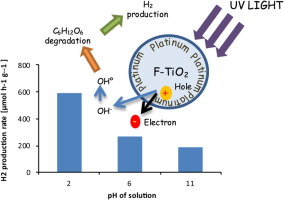
The present work reports the renewable hydrogen production by photocatalytic degradation of glucose over commercial and home prepared TiO2 modified by the simultaneous presence of fluorine and Pt (Pt-F-TiO2). The obtained materials were widely characterized by different techniques (XRD, SBF, UV-Vis DRS, XRF, SEM and TEM) and it was found that surface area, anatase/rutile ratio and the distribution and size of the platinum particles are important factors influencing the effectiveness of these materials in the H-2 production. The photocatalytic H-2 production from the glucose solution was 97 mu mol of H-2 after 3 h of irradiation on home prepared TiO2 modified by F and Pt addition, while a lower value corresponding to 31 mu mol of H-2 was obtained on commercial TiO2 modified by F and Pt, after 3 h of irradiation. The hydrogen production rate increased by decreasing the initial pH of solution reaching the highest value of about 590 mu mol h(-1) g(-1) after 3 h of irradiation time at pH = 2. Accordingly, sugar containing wastewaters from food industry has the potential for producing hydrogen by photocatalytic process while removing organics before disposal or reuse.