


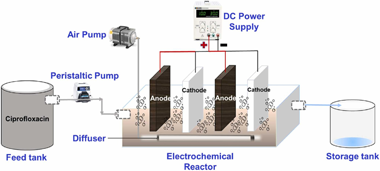
Ciprofloxacin (CIP) is a fluoroquinolone antibiotic that is widely used across the globe and its release is a serious concern due to its persistent nature, partial degradation, and simple transport through different environmental matrices. Pharmaceuticals have been degraded effectively by electrochemical oxidation. Exploring ways to in-crease the mineralization of these compounds while maintaining low power consumption is important. In this study, the treatability and degradation of CIP were investigated by using cobalt oxide-coated stainless steel (SS) electrodes in a lab-scale electrochemical (EC) reactor. The performance of the electrochemical reactor was determined under various operational conditions. The feed wastewater was synthetically prepared in the laboratory with varying concentrations of CIP ranging from 8 to 41 mg/L and the EC reactor was operated with an applied voltage and airflow rate of 2.6-9.3 volts and 1.6-3.5 L/min, respectively. A 3-factor central composite experimental design (CCD) was developed by using response surface methodology (RSM) in Design-Expert software. At a residence time of 27 min, initial concentration of 25 mg/L, airflow rate of 2.5 L/min, and applied voltage of 6 volts, the EC reactor achieved a removal efficiency of 70.8% for CIP with SS electrodes. On the contrary, the removal efficiency was increased to 91.5% at a reduced residence time of 21 min with cobalt oxide (Co3O4) coated over SS plates. The results indicated that Co3O4@SS electrodes resulted in better removal efficiency of CIP at a lower residence time. This system can be used as a robust benchmark for a single or consortium of antibiotics present in domestic and hospital wastewater.