


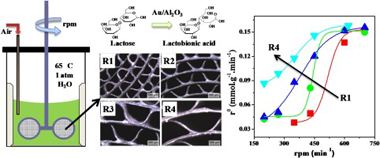
The performance of rotating metallic monolith stirrer reactor was studied for selective lactose oxidation in liquid phase at 65 degrees C, atmospheric pressure and with air as oxidant agent. The Au/Al(2)O(3)deposition on metallic substrates was performed by wash-coating, producing catalyst coating thicknesses between 5 and 20 mu m. Monoliths with different configuration (channel size between 0.36 and 1.06 mm) were used as stirrer blades in a batch reactor. Internal and external mass transfer limitations were observed during liquid phase lactose oxidation. For stirring rates equal or higher than 600 rpm there were no important external diffusional restrictions and this was also independent of the monolith configuration. Coating with thickness higher than 15 mu m presents loss of catalyst effectiveness due to internal diffusional restrictions. Excellent stability in the catalytic tests was obtained after three regeneration-reaction cycles. Regeneration was carried out at 400 degrees C in air flow. Gold particle size distribution in the monolith washcoat, determined by TEM before and after reaction, was homogeneous with a medium size of around 5 nm. This is in agreement with the very good reproducibility and stability obtained in the catalytic tests. After calcination at 500 degrees C, some sintering and a heterogeneous distribution of metal particle size was observed, accompanied by a slight loss in catalyst activity. It is concluded that metallic monolith stirrer reactors are a promising application for selective lactose oxidation in liquid phase.