


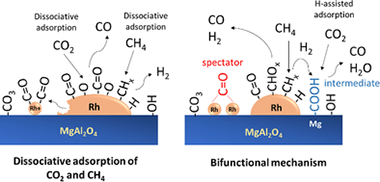
In this work, the reforming of model biogas was investigated on a Rh/MgAl2O4 catalyst. In situ transient and steady-state diffuse reflectance infrared Fourier transform spectroscopy (DRIFTS) measurements were used to gain insight into the reaction mechanism involved in the activation of CH4 and CO2. It was found that the reaction proceeds through of an initial pathway in which methane and CO2 are both dissociated on Rh metallic sites and additionally a bifunctional mechanism in which methane is activated on Rh sites and CO2 is activated on the basic sites of the support surface via a formate intermediate by H-assisted CO2 decomposition. Moreover, this plausible mechanism is able to explain why the observed apparent activation energy of CO2 is much lower than that of CH4. Our results suggest that CO2 dissociation facilitates CH4activation, because the oxygen-adsorbed species formed in the decomposition of CO2 are capable of reacting with the CHx species derived from methane decomposition.