


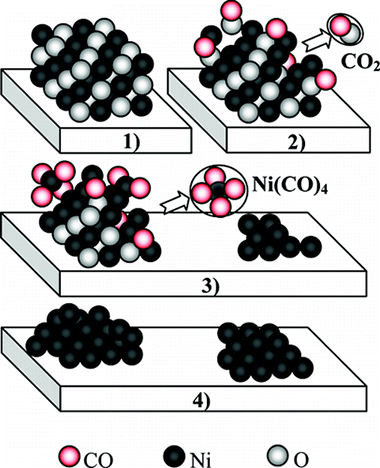
The effect of a reduction process with CO or H-2 on the Size of nickel particles in Ni/ZrO2 dry methane reforming catalysts have been studied by means of in situ X-ray Spectroscopy (XAS) and Diffuse Reflectance FTIR Spectroscopy (DRIFTS). Our results clearly indicate that a high temperature treatment with CO increases the dispersion of the nickel metallic phase. XAS results have shown a lower coordination number of Ni in the sample treated with CO than that reduced with H-2. From the DRIFTS results, it can he established that, under the CO treatment, the formation of Ni(CO)(4) complexes corrodes the nickel particles, decreasing their size. The formation of these gas molecules occurs without measurable losses of nickel from the catalyst which maintains the same nickel content after the hydrogen or the CO treatment at high temperature:Therefore, this airborne nickel compound, by colliding with the zirconia surface, must deposit the nickel metal metal atoms around onto the support. This behavior is evidence of an important interaction b etween nickel and zirconia surface as unlike other supports there is no losses of nickel during the dispersion process on zirconia. Although different effects of CO on nickel catalysts have been previously described, we have found for the first time several experimental evidences demonstrating the whole redispersion phenomenon.