


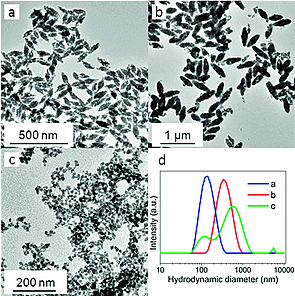
A new room-temperature method has been developed that yields, for the first time in the literature, uniform and well-dispersed CaWO4 nanospindles. This method is based on the use of microemulsions consisting of aqueous solutions of Ca2+ and WO42- precursors, cyclohexane as the organic medium, Triton X-100 as the surfactant, and n-octanol as the cosurfactant. We show that the formation of uniform nanospindles requires a restrictive set of experimental conditions. These particles crystallize into the tetragonal CaWO4 phase and emit blue-green luminescence when excited by UV radiation. The reported method is also useful for doping the CaWO4 spindles with Eu3+ or Dy3+ cations, resulting in multicolor emissions (red for Eu3+; white for Dy3+). The luminescence is much stronger when excited through a WO42–Ln(3+) (Ln = Eu or Dy) energy-transfer band than through the f-f transition bands of the Ln(3+) cations. Interestingly, because of the white luminescence associated with the Dy:CaWO4 nanophosphor, it might be useful for LED technologies. Luminescence dynamics and energy-transfer efficiency have been analyzed to determine the optimum phosphors. Finally, the Eu-doped CaWO4 nanospindles also showed excellent X-ray attenuation efficacy, which confers double functionality to this material as both a luminescence bioprobe and as a contrasting agent for X-ray computed-tomography.