
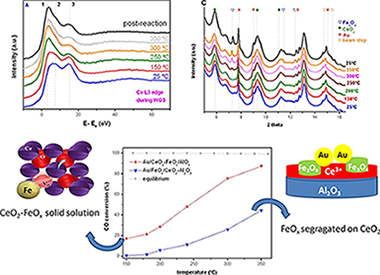
In this work an in situ XRD and XANES study of two gold catalysts supported on iron-promoted ceria–alumina carriers was carried out during the water-gas shift reaction (WGS). The first catalyst, Au/CeO2–FeOx/Al2O3, was prepared using a commercial alumina support in order to obtain a Ce–Fe oxide solid solution and in the second one, Au/FeOx/CeO2–Al2O3, an iron oxide monolayer was deposited onto a ceria–alumina commercial support to promote its redox properties. Catalytic activities in the WGS were remarkably different for both systems. The catalytic activity of the Au/CeO2–FeOx/Al2O3 catalyst was higher than the one shown by the Au/FeOx/CeO2–Al2O3 catalyst that resulted active at much higher temperatures. In situ XRD demonstrates the formation of magnetite (Fe3O4) during the WGS reaction and the presence of big gold particles, ca. 21 nm in diameter, in the low-activity system. This in contrast to the high-activity system that shows undetectable gold nanoparticles and the absence of diffraction peaks corresponding to magnetite during the WGS. The data obtained using in situ XANES states that Ce4+ species undergo reduction to Ce3+during the WGS for both catalysts, and also confirms that in the high-activity catalyst iron is just present as Fe3+ species while in the low-activity catalyst Fe3+ and Fe2+ coexist, resulting in iron spinel observed by XRD. These results allow us conclude that the Au/CeO2–Fe2O3/Al2O3 catalyst is a suitable catalyst for WGS when avoiding the formation of magnetite, in such a case Fe3+ species favors reduction and water splitting increasing the catalytic activity in the WGS reaction.