


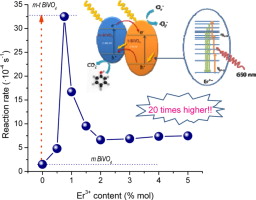
Er-BiVO4 has been synthesized by means of mw-assisted hydrothermal method having good photoactivity under sun-like excitation. It is stated that the precursor addition sequence plays a critical role which determine the further structural feature of BiVO4. From the structural and morphological characterization, it can be demonstrated that the presence of Er3+ would induce the stabilization of the tetragonal phase probably due to the formation of tetragonal-ErVO4 seeds previous to BiVO4 formation. The best photocatalytic performance is attained for the sample with 0.75 at% Er3+ content. At this dopant loading a mixture of tetragonal and monoclinic phase (70% tetragonal) is obtained. The dramatic increase in the photocatalytic activity for 0.75 at% Er-BiVO4 is related to the occurrence of such heterostructure. For this system, the MB degradation rate constant appears drastically higher as bare m-BiVO4. Furthermore, activities of photocatalysts for visible-light-driven O2 evolution have been evaluated, demonstrating that the photocatalytic activity of this Er-doped system (O2 evolution rate, 1014 μmol g−1 h−1) is 20 times as that of undoped m-BiVO4 (O2 evolution rate, 54 μmol g−1 h−1). From the obtained results, the cooperative conjunction of electronic and luminescence mechanism involved in the reaction is proposed to be the origin of the enhanced photocatalytic efficiencies of such systems.