

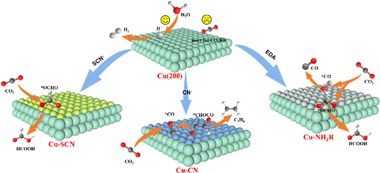
The development of efficient strategies to tune the CO2RR selectivity of Cu-based catalytic interfaces, especially on specific domains, such as Cu (200) facets with high activity toward competitive hydrogenation evolution reaction (HER), remains a challenging task. In this work, Cu-based catalytic layers with thiocyanate (-SCN), cyanide (-CN), or ethylenediamine (-NH2R) coordination linkages are prepared on Cu nanocolumns arrays (Cu NCAs) with predominant (200) exposed facets. The coordination of these ligands induces more Cu+ species and inhibits the adsorption of H & lowast; on the Cu (200) facet, leading to enhanced CO2RR performance and substantially suppressing the competitive HER. The faradaic efficiency (FE) of Cu-SCN, Cu-CN, and Cu-NH2R NWAs for producing HCOOH, C2H4, and C1 mixture products (HCOOH and CO) reach to 66.5%, 21.1%, and 57.1%, respectively. In situ spectroscopic studies reveal Cu-SCN, Cu-CN, and Cu-NH2R exhibit more reasonable adsorption energy toward & lowast;OCHO, *CO, and *COOH intermediates, promoting the HCOOH, C2H4, and C1 mixture generation, respectively. This study might provide a new perspective for the development of high-performance Cu-based CO2RR catalytic electrodes based on the combination of various commercial free-standing Cu substrates and organic/inorganic ligands. (c) 2024 Elsevier Ltd. All rights are reserved, including those for text and data mining, AI training, and similar technologies.