


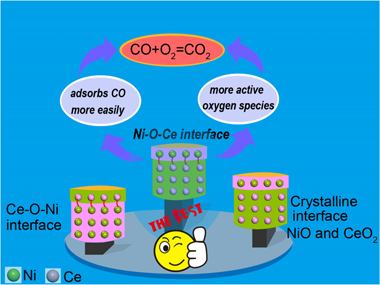
In contemporary catalytic interface exploration, experimental studies often take a backseat to theoretical simulations, hindering the development of pristine catalytic interfaces. This research leverages monolayer dispersion theory to design an efficient CO oxidation catalyst through precise manipulation of non-precious metal NiO-CeO2 interfaces. Employing the pioneering XRD extrapolation method, we fabricated monolayer dispersed Ni-O-Ce and Ce-O-Ni interfaces, unlocking insights into their impact on the CO oxidation mechanism. The method accurately quantified monolayer dispersion capacities: 0.526 mmol NiO/(100 m2 CeO2) for NiO/CeO2 and 0.0638 mmol CeO2/(100 m2 NiO) for CeO2/NiO, revealing intricate interactions between active components and supports. Utilizing numerical values derived from monolayer dispersion theory, we constructed CeO2-sup- ported NiO (Ni-O-Ce) and NiO-supported CeO2 (Ce-O-Ni) catalysts in a monolayer dispersed state. The Ni-O-Ce interface, generating abundant oxygen vacancies, significantly enhanced CO adsorption and facilitated surface reactive oxygen species production, leading to a remarkable 14-fold increase in intrinsic CO oxidation activity and a notable 4.2-fold improvement in water resistance. Integrating XRD extrapolation, H2-TPR, O2-TPD, COTPD, XPS, Raman, and in situ IR techniques, our study demonstrates the feasibility of crafting efficient catalysts with monolayer dispersed atomic-scale catalytic interfaces to elucidate the mechanisms underlying catalytic interface effects on CO oxidation.