


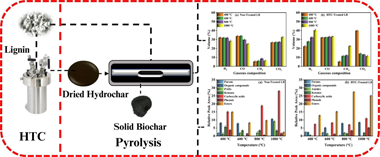
This research illustrates the efficacy of hydrothermal carbonization (HTC) as a pretreatment method to improve the pyrolytic performance of wood-derived lignin-rich lignocellulosic biomass (LB), supported by thorough characterization of its derived products such as syngas, tar, and biochar. A systematic comparison of non-HTC-treated LB and HTC-treated LB through their respective pyrolytic-derived biochar (NLB, HLB) obtained across temperatures (400-1000 degrees C) revealed their basic structural and reactivity variations. HTC resulted in a new carbonyl peak with a 28 % increase in CO concentration in derived biochar, with partial aromatization evidenced by CC bonds at 1509 cm(-)(1) . Spectroscopic analysis confirmed that HTC promoted a defective carbon structure in derived biochar while enhancing its crystallinity and maintaining its integrity even at higher temperatures. XPS analysis demonstrated that at 1000 degrees C, HLB-T-10 retained active oxygen functionalities, while its associated pyrolytic products H-2 and CO boosted from 22.45 % to 40.4 % and 32.3-33.4 %, respectively, with drastically lowered CO2 emissions from 39.95 % to 11.5 %. Regulated deoxygenation routes cause tar composition to shift toward desirable aromatic chemicals. This comprehensive strategy offers a sustainable valorization technique that increases syngas generation efficiency, lowers emissions, and optimizes biorefinery product selection.