


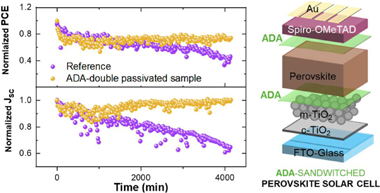
Metal halide perovskite solar cells (MHPSCs) hold great promise due to their high efficiency and low fabrication costs, but their long-term stability under environmental conditions remains the main challenge. However, their long-term operational stability under environmental stress remains a critical limitation for commercialization. In this work, we explore a dual passivation strategy using ultrathin adamantane-based plasma polymer (ADA) films, deposited via remote plasma-assisted vacuum deposition (RPAVD), to enhance the environmental stability of MHPSCs. The ADA layers are introduced simultaneously at both the electron transport layer (ETL)/perovskite and perovskite/hole transport layer (HTL) interfaces, offering a conformal, transparent, and thermally stable coating compatible with delicate perovskite films. This approach enables interfacial defect passivation and acts as a protective barrier against moisture and UV-induced degradation. Devices incorporating ADA layers exhibit significantly improved stability under harsh conditions, retaining 80 % of their initial efficiency after 4000 min over extended exposure to humidity and continuous illumination. These results demonstrate the potential of multifunctional plasma-polymer coatings for the scalable and robust fabrication of perovskite solar cells with enhanced durability.