


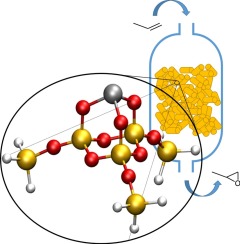
Catalytic epoxidation of alkenes plays an essential role in the transformation and synthesis of many organic chemicals. Ti atoms grafted on mesoporous silica, silylated on the surface, is considered the most active and selective catalyst for these reactions. However, the durability and robustness of the active centers remain as the main drawback in industry. In this paper, the characterization of industrial samples is combined with DFT calculations to rationalize the deactivation process of the catalyst and improve its performance. Silylating agents are characterized by experimental and simulated 29Si-NMR and their role in the catalytic mechanism is analysed. Potential deactivation processes are identified before, during and after the reaction. Modifications of the silylating agents and of the active center are proposed to improve the durability of the catalyst.