


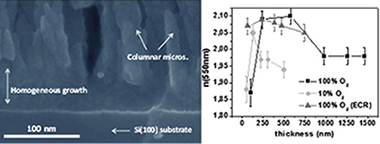
This work reports on the porosity and refraction index of TiO2 thin films as a function of the film thickness. Samples were fabricated by plasma enhanced chemical vapor deposition (PECVD) in a microwave electron cyclotron resonance (MW-ECR) reactor at room temperature using titanium tetra-isopropoxide (MP) as precursor. Experimental parameters such as plasma gas composition (pure oxygen and argon/oxygen mixtures) and pressure (either ECR conditions or «normal» pressure, i.e. 10(-4) or 10(-3) torrs correspondently) were varied. The evolution of the thin film microstructure, porosity and optical properties is critically studied by AFM, SEM, water adsorption isotherms, ellipsometry and UV-Vis transmittance and the existence of a certain critical thickness (t(c)) demonstrated. The porosity of the films with thicknesses ranging from several tens of nanometers up to half a micrometer is evaluated by QCM-isotherms at room temperature. The dependency of this critical thickness with the plasma conditions is evaluated experimental and theoretically. Thus, the microstructure change at t(c) is attributed to a transition from a surface diffused dominated growth mechanism for t < t(c) to another where shadowing is predominant. Dynamic scaling analysis of the two regimes and their Monte Carlo simulation complete the reported study.