


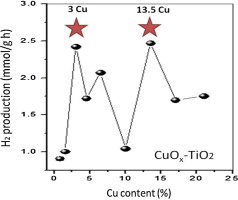
Copper oxides in contact with anatase correspond to promising materials with high activity in the photo-production of hydrogen by aqueous reforming of alcohols. By a single pot microemulsion method we obtained a series of Cu-Ti composite systems with controlled copper content in the 0-25 wt.% range. The scanning of such a wide range of composition led to the discovery of two well differentiated maxima in the photo-reaction performance. These maxima present rather high and relatively similar reaction rates and photonic efficiencies but are ascribed to the presence of different copper species. A multi-technique analysis of the materials indicates that the maxima obtained comes from optimizing different steps of the reaction; while the first would be connected with a positive effect on anatase charge handling performance the second seems exclusively related to electron capture by surface copper species.