


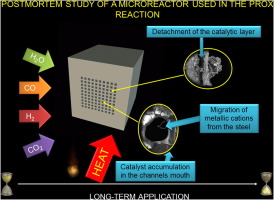
This manuscript is one of the few works presenting evidences of the effect of prolonged use of a microreactor. Our reactor has been designed for the PROX reaction. Near to 550 h of operation under different feed-streams, including CO2 and H2O, in the 100-300 degrees C temperature range, and several regeneration cycles, and a final forced deactivation during similar to 360 h resulted in the permanent loss of activity of the microreactor. This could be attributed to some phenomena whose have compromised the chemical nature of the catalyst and that of the reactor including: displacement of the coating to the mouth of the channels, detachments and cracks of the catalytic layer, migration of some elements of the metallic substrate to the surface (Fe, Cr, Y), and deposition of carbonaceous species from the reaction over the catalytic layer and/or the metallic substrate. Furthermore, sulfur compounds were detected in both inlet and outlet zones of the microreactor, coming probably from a lubricant applied over the screws that sealed the assembling of the microreactor.
This is a first approach for understanding possible effects of deactivation during long-term applications of a microreactor in the PROX reaction that could be considered as a case study useful for future designs of this kind of devices. The presented information could be extrapolated to similar reactions where thermal treatments along with highly corrosive atmospheres would be applied, in order to carry out a more appropriate design of future generations» of microreactors, with a longer useful life. For that purpose not only the adequate selection of the catalysts must be done, but also the adequate choice of the fabrication material of the reactors is needed.