


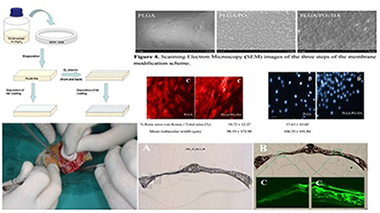
The novelty of this study is the addition of an ultrathin layer of nanostructured hydroxyapatite (HA) on oxygen plasmamodified poly(lactic-co-glycolic) (PLGA) membranes (PO2) in order to evaluate the efficiency of this novel material in bone regeneration. Methods: Two groups of regenerative membranes were prepared: PLGA (control) and PLGA/PO2/HA (experimental). These membranes were subjected to cell cultures and then used to cover bone defects prepared on the skulls of eight experimental rabbits. Results: Cell morphology and adhesion of the osteoblasts to the membranes showed that the osteoblasts bound to PLGA were smaller and with a lower number of adhered cells than the osteoblasts bound to the PLGA/PO2/HA membrane (p < 0.05). The PLGA/PO2/HA membrane had a higher percentage of viable cells bound than the control membrane (p < 0.05). Both micro-CT and histological evaluation confirmed that PLGA/PO2/HA membranes enhance bone regeneration. A statistically significant difference in the percentage of osteoid area in relation to the total area between both groups was found. Conclusions: The incorporation of nanometric layers of nanostructured HA into PLGA membranes modified with PO2 might be considered for the regeneration of bone defects. PLGA/PO2/HA membranes promote higher osteosynthetic activity, new bone formation, and mineralisation than the PLGA control group.