


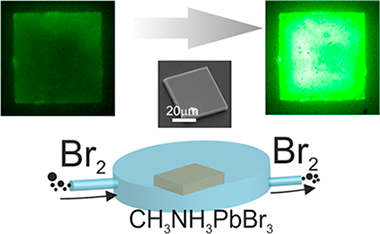
The peculiar defect chemistry of hybrid organic–inorganic lead halide perovskites is believed to be partially responsible for the outstanding performance of this solution-processed material in optoelectronic devices. While most effort has been put on the management of halide defects (the ones presenting the highest mobility) for CH3NH3PbI3, its bromide counterpart has not been so widely studied. Although the former is the material of choice for photovoltaics, the latter is present in most light-emitting applications. Here, we report how the exposure of CH3NH3PbBr3 single crystals to a bromine atmosphere strongly affects its emission properties. Such improvement takes place in the absence of apparent signs of degradation and remains for tens of hours. We propose an explanation based on the defect structure for this material where bromine-related defects can act as deep or shallow traps. These results are of relevance for a material expected to be present in a new generation of solution-processed light-emitting devices.