

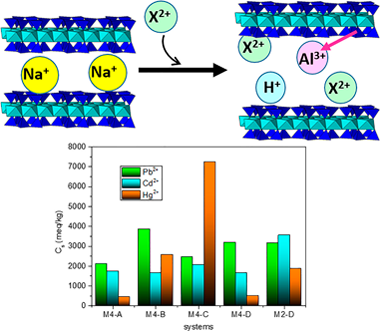
Heavy metal pollution has become one of the most serious environmental problems, demanding specialized remediation mechanisms. Among the studied treatments, ion-exchange processes have been widely used due to their high remediation capacity, efficiency and fast kinetic. Here, the potential use of a new family of design micas as cation exchanger has been analysed. Micas with a layer charge in the range of brittle micas have been synthesized and their heavy metals cation exchange capacity analysed as a function of the nature of the heavy metal cations (Pb2+, Cd2+ or Hg2+), the nature of the counterions (Cl− or NO3−), concentration of the solutions and the micas layer charge. A cation exchange ratio between 35% and 154% of their cation exchange capacity (CEC) was achieved, being more efficient when mica layer charge diminished. In general, the maximum adsorption capacity followed the trend: Hg2+ > Pb2+ > Cd2+. The efficiency of the cation exchange and adsorption mechanism of the synthetic micas depended on the experimental conditions and they were more efficient than raw and modified natural clay minerals.