



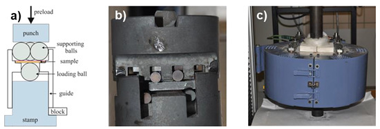
In this work, the effect of the test configuration and temperature on the mechanical behaviour of cemented carbides (WC-Co) with different carbide grain sizes (d(WC)) and cobalt volume fractions (V-Co), implying different binder mean free paths (lambda (Co)), was studied. The mechanical strength was measured at 600 degrees C with bar-shaped specimens subjected to uniaxial four-point bending (4PB) tests and with disc specimens subjected to biaxial ball-on-three-balls (B3B) tests. The results were analysed within the frame of the Weibull theory and compared with strength measurements performed at room temperature under the same loading conditions. A mechanical degradation greater than 30% was observed when the samples were tested at 600 degrees C due to oxidation phenomena, but higher Weibull moduli were obtained as a result of narrower defect size distributions. A fractographic analysis was conducted with broken specimens from each test configuration. The number of fragments (N-f) and the macroscopic fracture surface were related to the flexural strength and fracture toughness of WC-Co. For a given number of fragments, higher mechanical strength values were always obtained for WC-Co grades with higher K-Ic. The observed differences were discussed based on a linear elastic fracture mechanics (LEFM) model, taking into account the effect of the temperature and microstructure of the cemented carbides on the mechanical strength.