


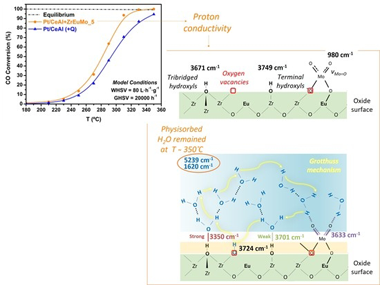
A conventional Pt/CeO2/Al(2)O(3)catalyst physically mixed with an ionic conductor (Mo- or Eu-doped ZrO2) was tested at high space velocity (20,000 h(-1)and 80 L h(-1)g(cat)(-1)) under model conditions (only with CO and H2O) and industrial conditions, with a realistic feed. The promoted system with the ionic conductor physically mixed showed better catalytic activity associated with better water dissociation and mobility, considered as a rate-determining step. The water activation was assessed by operando diffuse reflectance infrared fourier transformed spectroscopy (DRIFTS) studies under reaction conditions and the Mo-containing ionic conductor exhibited the presence of both dissociated (3724 cm(-1)) and physisorbed (5239 cm(-1)) water on the Eu-doped ZrO(2)solid solution, which supports the appearance of proton conductivity by Grotthuss mechanism. Moreover, the band at 3633 cm(-1)ascribed to hydrated Mo oxide, which increases with the temperature, explains the increase of catalytic activity when the physical mixture was used in a water gas shift (WGS) reaction.