

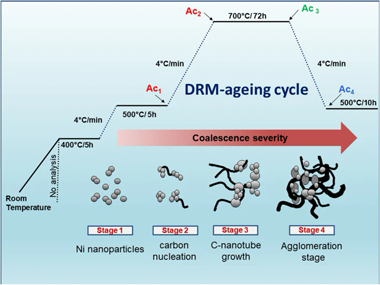
The importance of the dry reforming of methane (DRM) lies in its capability to upgrade two greenhouse gases (CH4 and CO2) into synthesis gas (CO and H-2), which is one of the main building block for synthesizing hydrocarbons. However, the Ni-based catalysts for DRM reaction usually have a major catalytic stability drawback. This works aims to assess the catalytic activity and stability of two Ni-based catalysts obtained from hydrotalcite (HT) precursors (i.e., NiAl-HT and NiMgAl-HT). The precursors, calcined (-c), reduced (-R) and spent samples were characterized by a series of techniques to gain insight into the influence of MgO over Ni-based catalyst in the drying reforming of methane. An in-situ ageing cycle process to speed up the deactivation of hydrotalcite-derived catalysts showed that the NiMgAl-HTc-R catalyst displayed a higher activity and resistance to coke formation (stability) than NiAl-HTc-R because of the introduction of Mg into hydrotalcite structure in the catalyst precursor. The presence of this element enhances several factors involved in the stability of Ni-based catalysts for the DRM process such as the reducibility and textural features of the catalysts, size and dispersion of Ni-0 nanoparticles and also maintains a good compromise between the acid and base properties of the solid catalysts.