


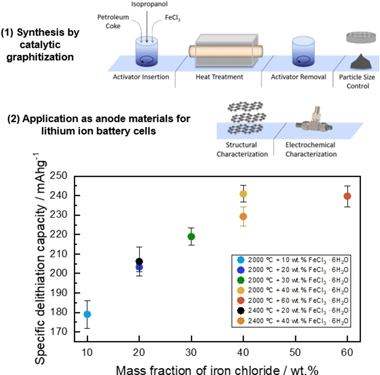
In this work, we systematically investigate the ‘catalytic’ graphitization of a biomass precursor (coffee ground) using 10-60 wt.% of the activator iron (III) chloride hexahydrate in a temperature range of 1000 degrees C-2400 degrees C. Special focus is put on the correlation of synthesis conditions, e.g., heat treatment temperature and mass fraction of iron chloride, with the electrochemical performance in carbon vertical bar vertical bar Li metal cells. The structural investigations of the materials reveal a positive impact of an increasing heat treatment temperature and/or mass fraction of inserted activator on the degree of graphitization and the delithiation capacity. However, a saturation point regarding the maximum degree of graphitization at 2000 degrees C and reversible capacity by the ‘catalytic’ graphitization approach using iron (III) chloride has been found. A maximum degree of graphitization of approximate to 69% could be reached by applying 2000 degrees C and 40 wt.% FeCl3 center dot 6H(2)O, resulting in a reversible capacity of 235 mAh g(-1).