


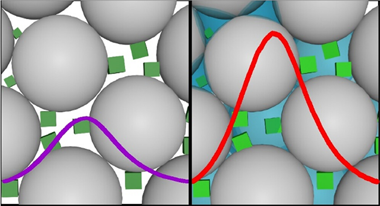
Herein we show that dispersing inorganic cesium lead bromide (CsPbBr3) perovskite quantum dots (QDs) in optical quality films, possessing an accessible and controlled pore size distribution, gives rise to fluorescent materials with a controlled and highly sensi t i v e response to ambient changes. A scaffold-based synthesis approach is employed to obtain ligand-free QDs, whose pristine surface endows them with high sensit i v i t y to the presence of different vapors in their vici n i t y . At the same time, the void network of the host offers a means to gradually expose the embedded QDs to such vapors. Under these conditions, the luminescent response of the QDs is mediated by the mesostructure of the matri x , which determines the rate at which vapor molecules will adsorb onto the pore walls and, eventually, condensate, filling the void space. With luminescence quantum yields as high as 60%, scaffold-supported ligand-free perovskite nanocrystals display intense photoemission signals over the whole process, as well as high photo-and chemical stabi l i t y , which allows illuminating them for long periods of time and recovering the original response upon desorption of the condensed phase. The results herein presented open a new route to explore the application of perovskite QD-based materials in sensing.