


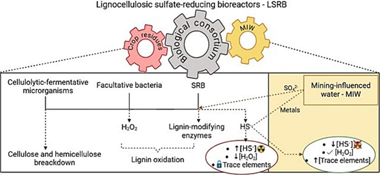
Research on the reutilization of crop residues has gained significant attention as a strategy for generating energy and high-value chemicals from renewable sources, while simultaneously reducing feedstock costs and mitigating environmental pollution. Crop residues have been effectively applied in lignocellulosic sulfate-reducing bioreactors (LSRBs) for the treatment of mining-influenced water. A comprehensive evaluation of the state-of-the-art in LSRBs reveals their potential for leveraging syntrophic aerobic-anaerobic interactions between sulfate-reducing bacteria and facultative species, alongside cellulolytic-fermentative microorganisms, to facilitate the pretreatment of lignocellulosic biomass for biorefinery applications. Key variables influencing the availability of enzymatic substrates and the activity of lignin-degrading enzymes are identified, along with strategies to enhance catalytic efficiency. Additionally, approaches to ensure the availability of trace elements and to control the production of toxic intermediates that may hinder treatment processes are elucidated. Prominent strategies include the application of microaeration and the use of co-substrates. An innovative aspect is the exploitation of metal sulfide precipitation to mitigate toxicity while preventing the sequestration of hydrogen peroxide – an essential substrate for enzymatic activity – by sulfides generated during the process. This review emphasizes the need for scientific advancements focused on optimizing the valorization of lignocellulosic residues. A particular focus is placed on advancing the understanding of lignin’s anaerobic degradation mechanisms, especially in systems co-treating lignocellulosic waste and mining-influenced waters. Such advancements hold promise for enhancing the efficiency and sustainability of biorefinery operations.