


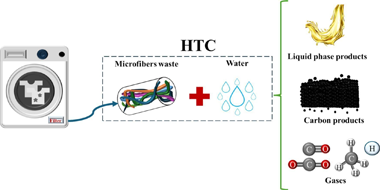
Microplastics are an emerging pollutant of concern. Many microplastics in the waters arise from washing synthetic textiles in residential and commercial washing machines. The present research evaluated the upcycling of this waste to carbon materials by hydrothermal carbonization. Real microfiber waste was collected using clothes washer and dryer microfilters. Via temperature and residence time screening (200 degrees C, 250 degrees C, 300 degrees C and 1 h, 4 h, 8 h) two temperatures of interest were determined (250 degrees C and 300 degrees C) for hydrothermal carbonization, for a residence time of 4 h. The results obtained in this research demonstrated that by varying the reaction conditions carbon production can be tailored, producing amorphous carbon or graphene/graphite. To this end, Raman spectroscopy results indicated the production of carbon nanomaterials; smaller particle sizes were detected after 250 degrees C-4h and 300 degrees C-4h treatments, (29.6 nm and 33.1 nm, respectively). Transforming microfibers into useful carbon nanoparticles via hydrothermal carbonization prolongs their lifecycle and mitigates environmental pollution. This process is an intriguing method of incorporating textile residue (microfibers) into the circular economy, where resources are perpetually recycled, and waste is avoided.